Celebrating the 190th Anniversary of
St Brigid’s Church, Miller’s Point
7pm Wednesday 14th May 2025
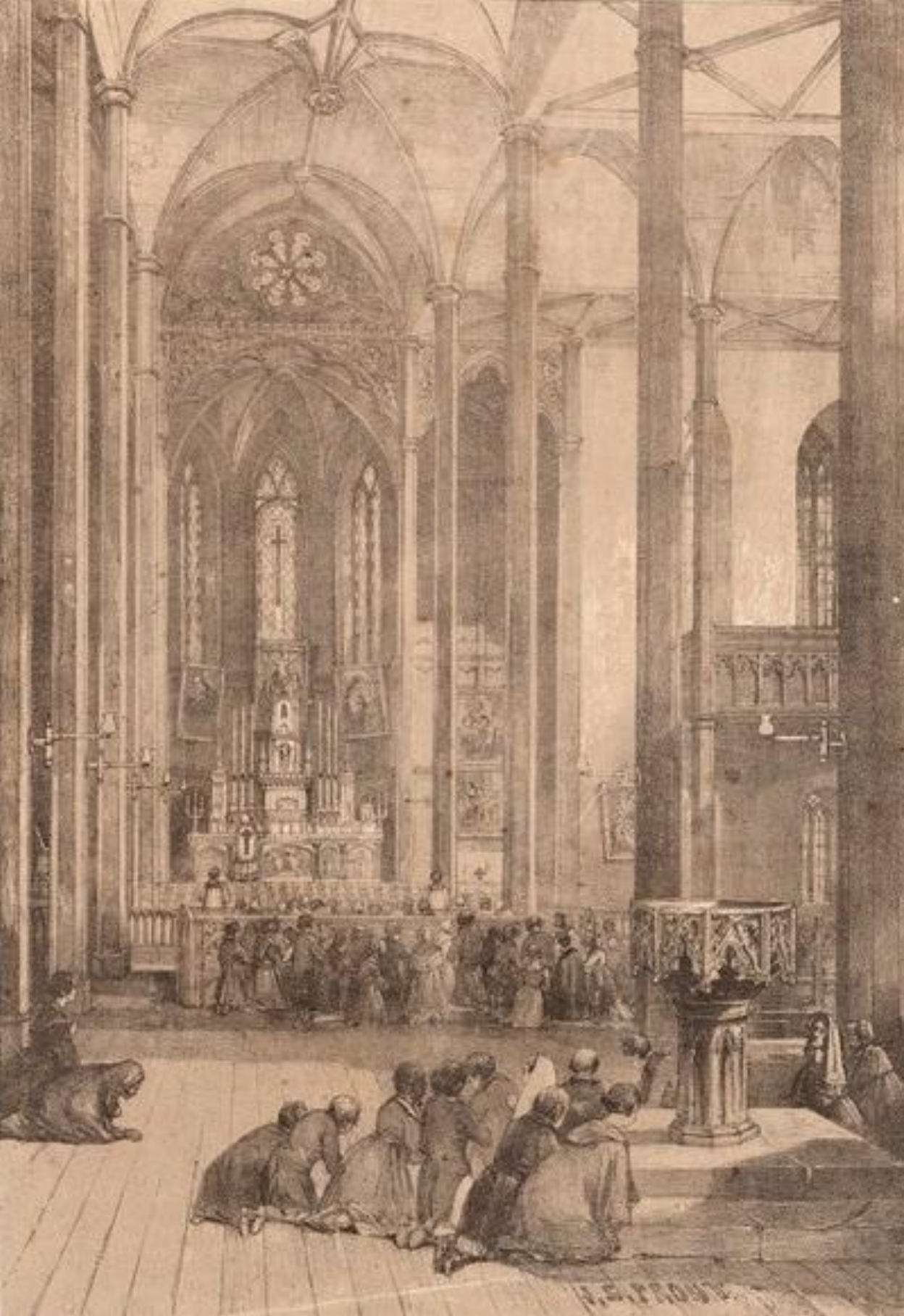
This program reimagines some of the music that might have been performed in the schoolroom and chapel of St Brigid’s church for occasional uniquely local celebrations, during the 1840s and 1850s, when musicians from the choirs of St. Mary’s cathedral and nearby St. Patrick’s church might have visited and performed music from their usual repertoire, both classical (in the form of mass settings and motets) and popular (hymns and simpler sacred songs).
Old St. Mary’s church, Sydney, was dedicated as the cathedral on the arrival in Sydney in 1835 of the first Catholic bishop of Australia, John Bede Polding. The building, as pictured above, was completely destroyed by fire in 1865, and a much larger modern replacement building erected on the same site.
In the same year that St. Mary’s became the cathedral, 1835, the foundation stone was laid for this, the first Catholic schoolroom and chapel at the north end of town, known as The Rocks, or Miller’s Point. It was only later, in 1844, that it was superseded by the nearby St. Patrick’s church as the parish church of the northern district of the city, but it remained in use as a local schoolroom, and also used as a chapel, thereafter.
Isaac Nathan (born England, 1792; died Sydney, 1864)
Jephtha’s Daughter, Hebrew melody, set by Nathan, with poetry by Lord Byron (London, 1815)
Aged almost fifty, the English composer Isaac Nathan arrived in the colony in 1841 and settled with his large family in Sydney. A quarter of a century after their first appearance, Nathan was still best known for his series or ‘Hebrew melodies’ (1815–16), arrangements of traditional Jewish melodies to specially written new texts by the poet Byron. Apparently based on an ancient and simple synagogue chant, this setting was generally acknowledged in both England and Australia to be one of the best and most effective of Nathan’s popular collection.
George Frideric Handel (1685-1759) arranged by Isaac Nathan
Angels Ever Bright and Fair from “Theodora” (HWV 68, London, 1749-50)
As sung by Mr. Palmer, at St. Mary’s Choral Society, as arranged with variations &c., expressly for his extraordinary soprano voice (Sydney, 1853)
Shortly after his arrival in Sydney in 1841, Nathan was appointed organist of St. Mary’s cathedral, probably largely at the prompting of the leading Catholic layman and musical amateur William Augustine Duncan (of whom more below). Although Nathan remained organist there for less than a year, he returned to the Catholic cathedral community a decade later to conduct the St. Mary’s Choral Society, a voluntary association of amateur singers, many of them young, that gave public concerts periodically in the cathedral seminary schoolroom. One member of the choral society was Nathan’s pupil, the male soprano singer, W. J. Palmer. This edition of Handel’s best-known air from the Old Testament oratorio Theodora notably includes the vocal ornaments added by Nathan to the original.
Traditional arranged Ludwig van Beethoven (1770–1827)
O Sanctissima (the Sicilian mariners’ hymn) (WoO 157, Vienna, c. 1815–20)
In Sydney in the 1850s, the Catholic layman and bookseller William Dolman (1831–1902) published cheap editions of collections of simpler Latin chants and popular Latin and English hymns for the use of Sydney Catholic congregations at mass and vespers. Among the popular hymns included were the Christmas hymn, “Adeste fideles” (as see below) and the so-called “Sicilian mariner’s hymn”, performed here in a simple arrangement by Beethoven.