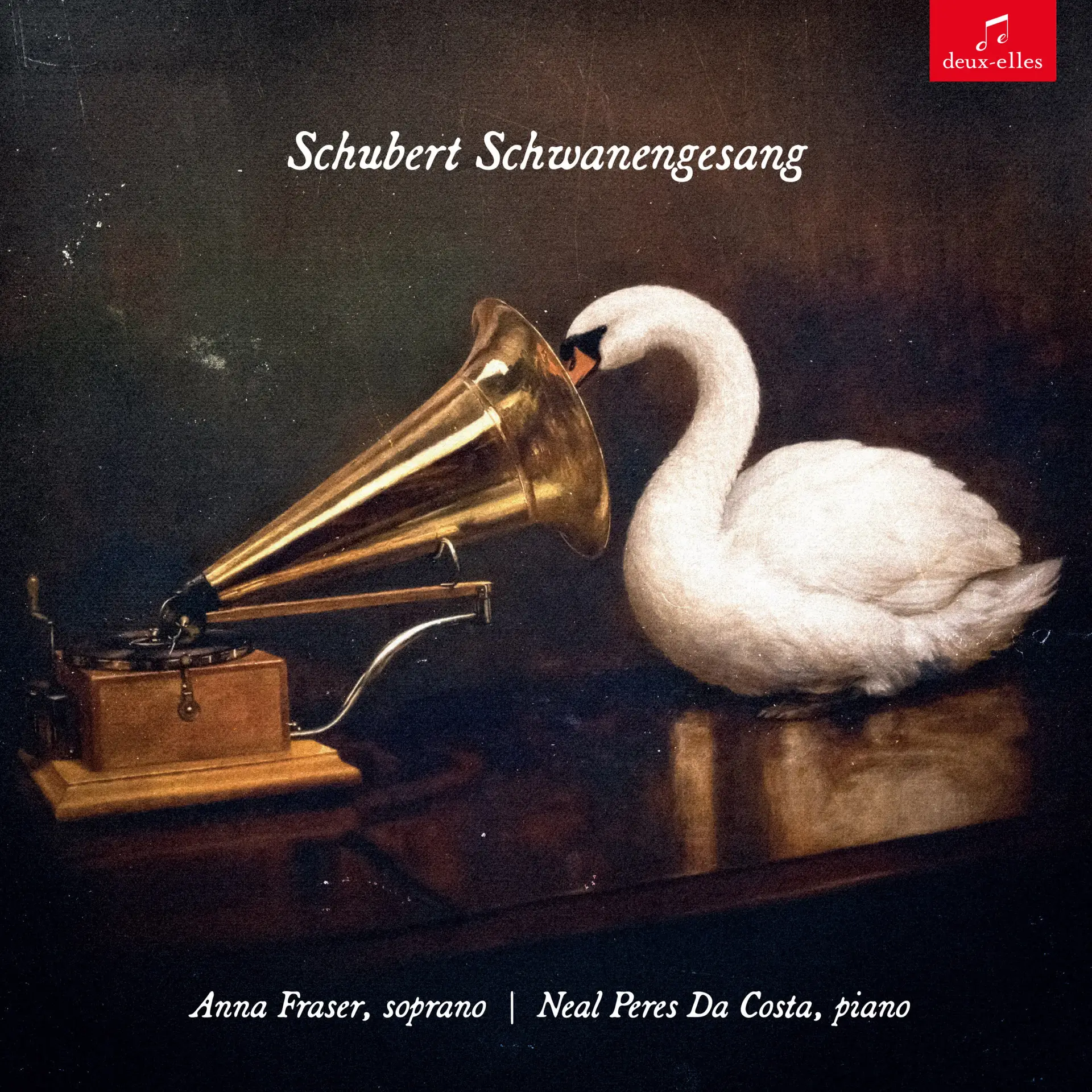
Schubert’s
Schwanengesang
Anna Fraser, soprano | Neal Peres Da Costa, piano
This is the second commercial recording to emerge from the groundbreaking Australian Research Council Discovery Project, The shock of the old: Rediscovering the sounds of bel canto 1700–1900, led by scholar-performer Neal Peres Da Costa. Following the success of his iconoclastic recording of Schumann’s Dichterliebe with baritone Koen van Stade (DXL1193), he joins forces here with soprano Anna Fraser to imagine the sound of Schubert’s own Schubertiades, with the help of an astonishing set of recordings of singers trained in the 1830s and 40s. Especially innovative are Fraser’s experiments with varying the timbre of her voice within phrases, guided by techniques described in Manuel Garcia’s vastly influential vocal method in combination with other historical sources. The result is startling at first, but delivered with a warmth and charisma that transcends all boundaries of style and convention.
Schubertiade
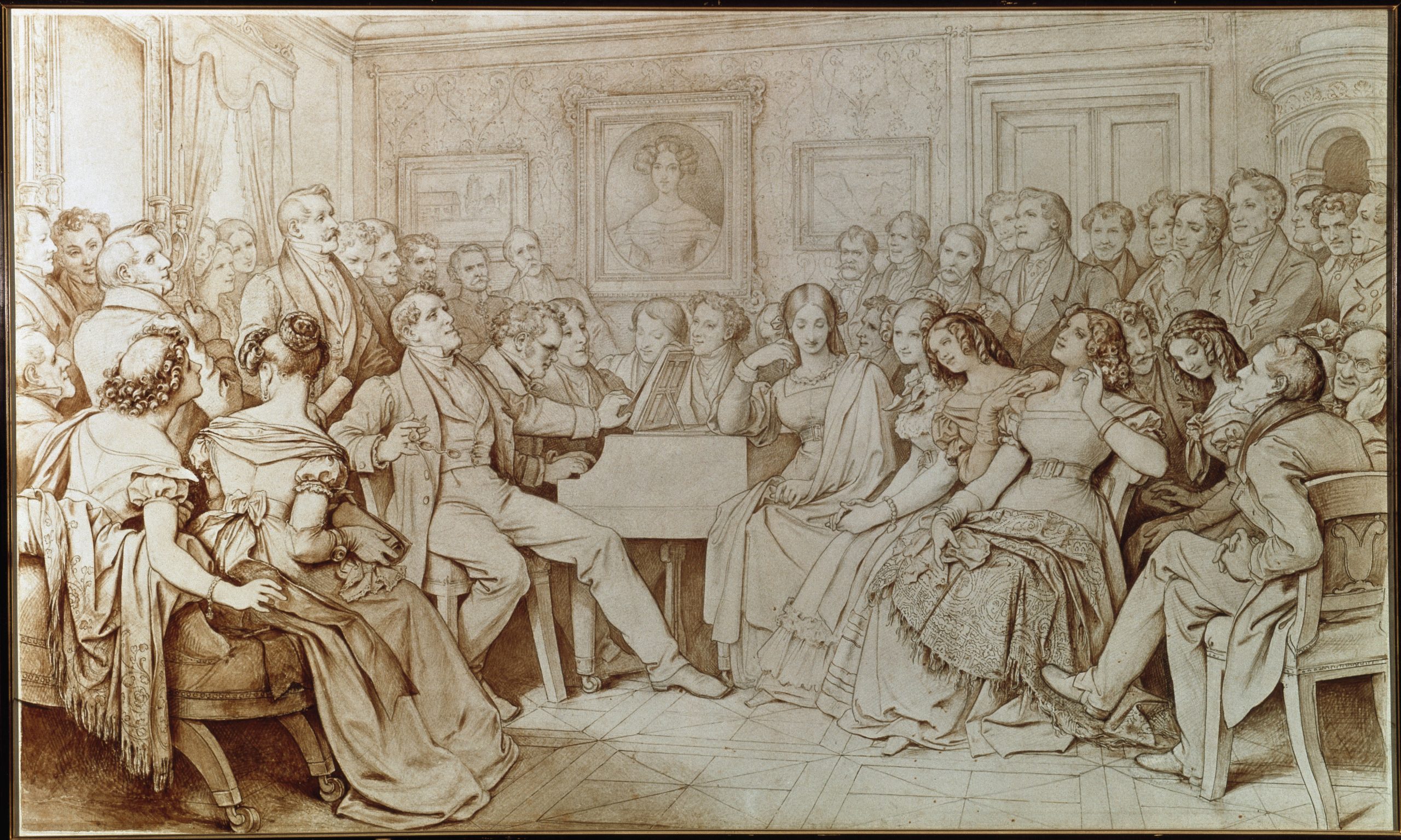
In 1868, Schubert’s companion—the Austrian painter Moritz Ludwig von Schwind (1804–1871)— sketched an intimate Schubertiade: Franz Schubert (1797–1828) at the piano, accompanying his favoured baritone Johann Michael Vogl (1768–1840). Their partnership, forged in private salons and public concerts, drew audiences into a world of song defined by immediacy, drama, and profound feeling. Schubert’s close friend Joseph von Spaun (1788–1865) recalled their performances that “delighted, shocked, thrilled, and often moved [audiences] to tears,” while Schubert himself wrote in 1825: “The way Vogl sings and I accompany, the way we seem to be one in such a moment, is something new and unheard of to these people.” Schwind’s image captures this unity— composer and singer channelling a declamatory art that treated poetry as living theatre, and music as its pliant, responsive partner.
What did listeners hear during those Schubertiades?
With no sound recordings from Schubert’s time, we turn first to evidence from the turn of the twentieth century, when recordings of singers and pianists (some trained in the 1830s and 40s) preserved a lineage of practice traceable back to Schubert’s time. These recordings, supported by detailed documentary evidence, reveal a sound world that privileged declamatory delivery through such practices as flexible tempo and rhythm, timbral variety (light and dark sounds), and myriad expressive nuances (sliding and trembling effects, pauses, articulation and agogic accents)—elements severely eroded through the march of twentieth-century modernism with its overarching doctrine of fidelity to the score. In this recording we explore how such practices might be embodied today, building a performance approach that is historically inspired yet artistically alive. By emulating historical recordings and using the knowledge gained as a lens through which to view documented practices from Schubert’ era, we reimagine his Lieder assembled under the title Schwanengesang with techniques that emphasise dramatic storytelling, textual clarity, and the expressive sounds and elasticity central to Schubert’s milieu.
Recording Details
Catalogue No: DXL 1231
Title: Schubert Schwanengesang
Artists: Anna Fraser (soprano), Neal Peres Da Costa (piano)
Barcode: 0666283123128
Playing Time: 65:38
UK Release: 22nd May 2026
UK Distribution: RSK, Tel: 01488 608900
Packaging: CD Digipak; Box 35
Declamation and the Signer’s Art
Written accounts paint Vogl as “our master of declamatory song.” A celebrated actor and singer, Vogl treated poetry as performance—shaping language with spoken inflections, sudden dynamic thrusts, registral contrasts, and rhetorical pacing. Documents of the era affirm that singers employed arbitrary embellishments—ornaments (trills, turns, mordents, portamento, tremolo), slides, and timbral shadings—to animate meaning. As the Austrian dramatist Eduard von Bauernfeld noted, Vogl’s expressive changes sometimes sparked friendly debate with Schubert, suggesting that the composer welcomed interpretive freedom when applied with taste and in service of the text.
Early recordings illuminate how late-nineteenthcentury declamation sounded in practice. For example, the Austrian stage actor Alexander Moissi’s (1879–1935) recitations of Goethe’s Erlkönig (1917, 1928) are startlingly theatrical. A trained singer, his voice moves through registers and colours, his timing and dynamics adjust to narrative contour, and the Erlking appears in a breathy falsetto threaded with eerie slides and tremulous effects. The recitation is music-like in its rhythm and timbre—Sprechgesang as expressive instrument—revealing a tradition in which speech and song inform one another.
Among singers, the Austrian-American Ernestine Schumann Heink (1861–1936) recorded Schubert’s Erlkönig in 1911 illustrating declamation at a highly sophisticated level. She differentiates the narrator, father, son, and Erlking (just as Moissi does) through timbre and register; uses agogic accents to stress syllables and meaning; bends tempo against the piano’s motoric pattern; and deploys subtle slides and trembling effects. Her background is storytelling: her actor-director husband, Paul Schumann (d. 1904), trained her to speak text before singing, emphasising phrasing, diction, and dramatic intention. The result is singing that treats text as master, tone colour as atmospheric and dramatic agent, and beauty of sound as one choice among many.
The Irish baritone Harry Plunkett Greene (1865–1936)—who recorded in 1934 Schubert’s “Der Leierman” from Winterreise in a highly spoken style—provided an informative singing taxonomy (1912) clarifying the singer’s interpretive style palette: bel canto (the primacy of beauty and legato), declamation (dramatic expression and vivid colour), diction (text forward), and a fourth style that fuses bel canto and diction within a single phrase. He emphasises that the singer’s “aesthetic diagnosis” of a song determines its technical treatment—an insight we take as an invitation to re-centre Schubert performance on poetic meaning and dramatic integrity, rather than uniform tone or unbroken line.
The Three E’s
We re-animate the expressive qualities of Schubert’s sound world by engaging artistically —through emulation, embodiment and extrapolation— with rich sources of performing practice evidence from the nineteenth century. These artistic processes respond to the hidden nature of vocal production (internal laryngeal placement, micro-adjustment of pharyngeal space), which defies simplistic description. By listening, imitating, and then internalising the feeling (physical sensation and emotion) of expressive effects, we expand interpretative range and nuance while keeping practice historically anchored.
Emulation is the close imitation of early recordings by singers—for example, Schumann Heink, Johanna Gadski (1870–1932) and Lev Sibiryakov (1869–1942)—trained before the modernist uniformity of technical approach had become standard. The process embeds the feel of pre-modern timing, articulation, timbre, and ornamentation, counteracting habits of today’s training such as relative tempo and rhythm stability, long and uninflected lines (legato), constant unvarying vibrato, infrequent portamento, and evenly equalised registers—smooth, homogeneous, and uninterrupted across the range, with no perceptible break, bump, or change of quality.
Embodiment involves in-depth honing of the emulation stage to absorb and embed the historical singer’s expression to effect a metamorphosis “in which the living musician feels the dead musician’s practices in their own body and allows these to sound out anew, as their own” (Fraser and Peres Da Costa, 2026). We experiment cyclically—testing portamento, tremolo/vibrato variations, registral shifts, speech-like rhythmic inflection (declamato, stilo parlante), agogic accents, dynamic hairpins, and timbral shading (light and shade or chiaroscuro produced by flexible laryngeal height and pharyngeal shapings). The aim is to embody these effects physically to feel how different colours and articulations animate words and structures, and then to integrate these instinctually
Extrapolation occurs through practical trials to: i) translate (reverse engineer) information from documentary sources into sound; and ii) create novel interpretations of repertoire (across the eighteenth and nineteenth centuries) for which there are no relevant historical sound recordings.

classikON Review | Anna Fraser & Neal Peres Da Costa – Schwanengesang
Pepe Newton
Love, longing and loss have inspired composers for centuries, but few explored the emotional landscape of the human heart more profoundly than Franz Schubert. His songs inhabit a world where babbling brooks carry messages to absent lovers, spring breezes awaken desire, distant towns become symbols of grief and memory and a faithful carrier pigeon ultimately reveals itself to be something far more elusive: Sehnsucht – that uniquely German yearning for something forever beyond reach.
This remarkable recording from soprano Anna Fraser and scholar-pianist Neal Peres Da Costa reimagines Schubert’s Schwanengesang not as a museum piece, but as audiences may once have encountered it in an intimate nineteenth-century Schubertiad. Interspersed with three songs from Johann Anton André’s Lieder und Gesänge, the program unfolds as an emotional journey rather than simply a posthumously assembled collection.
Fraser’s singing is fearless. Drawing on nineteenth-century vocal techniques explored through the Australian Research Council project The Shock of the Old, she constantly varies colour, register and vocal timbre in response to the poetry. It is a powerful dramatic language. Her German diction is exemplary, every word delivered with clarity and expressive intent.
The recording’s real revelation, however, is Peres Da Costa’s playing on a replica c.1819 Conrad Graf fortepiano. Its transparent, intimate sound transforms familiar songs. In Liebesbotschaft (Message of Love), Schubert’s murmuring brook ripples effortlessly beneath the voice, while Ständchen (Serenade) lingers with exquisite flexibility, the nightingale calls emerging naturally from the accompaniment. Elsewhere, the instrument darkens dramatically: the ominous weight of Aufenthalt (Sojourn), the suspended stillness of Am Meer (By the Sea) and the haunting psychological landscape of Der Doppelgänger (The Dopperlganger) demonstrate an astonishing palette of colour. The piano at times sounds harp-like to my ear as though the strings were strummed rather than hammered – sublime.
Throughout, words remain paramount and I would encourage any listener to have the translations of the poetry at hand to ponder over as these short beauties unfold. As the excellent booklet explains, Peres Da Costa draws on Liszt’s transcriptions, historical treatises and early recordings to shape tempo, articulation, pedalling and phrasing, allowing music and poetry to become inseparable. The accompanying essays and complete texts with English translations are a great read, offering genuine insight into both the scholarship and the emotional world of the songs.
By the final song, Die Taubenpost (The Carrier Pigeon), Schubert offers no tidy resolution. Love remains unfulfilled, grief endures, and yet hope persists. The faithful carrier pigeon is revealed to be Sehnsucht itself: longing as life’s constant companion. Fraser and Peres Da Costa have created far more than an historically informed performance. They have invited us to hear these extraordinary songs as living theatre, where research serves expression and every phrase feels newly discovered.

Fine Music Breakfast | 21 July 2026
Julie Simonds with studio guest Anna Fraser