Johann Anton André
Sept. 2023 Early music Ensemble
Sydney Conservatorium of Music Greenway Series
SCM Early Music Ensemble: Re-engaging the Art of Story Telling in Music
What did Beethoven’s famous Fifth Symphony sound like at the first Viennese performance in 1808? And how did the Italian soprano Dorotea Bussani (1763–1809) transmit Cherubino’s crazed infatuation for the Countess to the audience, in Mozart’s aria “Voi che sapete” at the 1787 premier of his opera The Marriage of Figaro in Vienna? Without a time machine we will never find the answers to these questions. But, one thing is certain: musicians (singers and instrumentalists) from the eras of Mozart, Beethoven, Schubert and other composers of the 18th and 19th centuries delivered music in imaginatively expressive ways that projected stories to the audience. Through the employment of a myriad of expressive devices including inflections of tone and timing, musicians took their listeners on scintillating journeys, sometimes whispering, sometimes shouting, at times calm, sorrowful or languid, at others frantic or angry.
“Liebe” (Love) is a beautiful little song from the third book of Lieder und Gesänge (1818) by Johann Anton André (1775–1842), best known for being Mozart’s publisher. “Liebe” takes us into a fascinating world of expressive possibilities. André’s extensive markings provide a treasure trove of information, a veritable masterclass in methods of storytelling in musical delivery with frequent changes of tempo, a plethora of accent, crescendo and diminuendo signs that underscore the words and their meaning. For example, the first stanza has three changes of tempo in the space of 5 bars (see translation below):
“Strong is the rough hand of death” crotchet = 54
“but stronger still is love” crotchet = 66
“and tightly embraces the band of the grave, but firmer hearts love” crotchet = 76
Such changes of tempo to enhance the increasingly positive message of the text would hardly have been envisaged but for this information.
Johann Gottfried Herder (1744-1803)
“Liebe” (English translation: Anna Fraser)
Stark ist des Todes rauhe Hand,
Doch stärker noch ist Liebe;
Und fest umarmt des Grabes Band,
Doch fester herzt die Liebe.
Die Kohle glimmt, das Feuer sprüht,
Doch höher flammt und tiefer glüht
Die Wonne süßer Liebe.
Kein Wasser löscht ihr Feuer aus,
Kein Strom ertränkt die Liebe.
Böt’ ein Verschmähter Hof und Haus
Für ungeschminkte Liebe,
Umsonst wär’ alles Gut und Geld,
Denn fern von Kauf und Gold und Welt,
Bleibt ewig frei die Liebe.
Strong is death’s rough hand,
But love is even stronger;
And tightly embraced the grave’s band,
But love is stronger.
The coal glows, the fire sparkles,
But higher flames and deeper glows
The bliss of sweet love.
No water quenches their fire,
No river drowns love.
Offer a scorned farm and house
for unvarnished love,
Everything would be good and money for free.
Because far from purchase and gold and world,
Love stays free forever.
The beautiful second movement from André’s little-known E flat Symphony (1805) is an instrumental recitative and aria to which we are applying the principles of expression discovered in “Liebe”. This is likely to be the first time André’s “Liebe” and his symphonic movement will be heard in Australia.
Jul. 2024 Clive Brown Workshops
Aug. 2024 Royal Sydney Yacht Squadron
Aug. 2024 Early Music Ensemble
Sydney Conservatorium Of Music Greenway Series
SCM Early Music Ensemble
Mood, Emotion, and Expression:
The art of storytelling in music
At the beginning of the nineteenth century, Johann Anton André—famous for his publication of Mozart’s music—bothered to indicate in his songs frequent changes of tempo (giving metronome figures) and various signs indicating rhythmic nuance to underscore the everchanging meaning of the text. At the other end of the continuum we might consider the words of the German cellist Hugo Becker (1863–1941) who explained in 1929: “Animato [getting faster] is the marking for that feeling that makes us talk faster when relating events that affect us very strongly […] Meno or più tranquillo [less or more tranquil], on the other hand, should check the flow of the narrative; it can be used either as a calming effect, or to underline the meaning of a particular place, in order to bring out something musically significant.” Such evidence points to the use of narrative practices to tell stories in spellbinding ways.
Lieder und Gesänge Book 3 (1818)
Dec. 2024 Vienna Symposium
Johann Anton André’s Lieder und Gesänge: A Didactic Source for Singers and Accompanists
How can 19th-century expressive score markings inform emotional delivery in classical singing? And to what extent can such knowledge expand vocal artistry in the present time? These questions have been the focus of practice-led research undertaken in the Australian Research Council funded Discovery Project—The shock of the old: Rediscovering the sounds of bel canto 1700–1900. In this project, we have systematically extrapolated historical singing styles in a two-step methodological process: i) emulating (imitating) early vocal recordings to embody late bel canto aesthetic practices as an imperative precursor to, ii) undertaking iterative (cyclical) processes of experimentation and reflection, trialling sound effects against documentary sources on singing. Such experimentation relies to a great extent on individual (intuitive) artistic responses.
It has been illuminating to sonify scores annotated with expressive verbal instructions by the celebrated nineteenth-century singing teacher Manuel García (1805–1906) – taking into account his detailed advice on vocal production and expressive performing practices. Such engagement has also facilitated extrapolation back to earlier eras through, for example, sonifying annotated scores by the vocal pedagogue Domenico Corri (1746–1825) who studied with the famous eighteenth-century pedagogue Nicola Porpora (1686–1768). Of particular significance has been the discovery of four volumes entitled Lieder und Gesänge mit Begleitung des Piano-Forté (published between 1818 and 1822) by the little-known German publisher and composer Johann Anton André (1775–1842). André’s compositions and his remarks of performance are a veritable treasure trove of evidence about song delivery in the early nineteenth century. Of particular interest is André’s obvious regard for principles of declamation encapsulated in his instructions for frequent modification of tempo, dynamic shading, and accents. These instructions (seemingly didactic in nature) underscore the emotions of the text. These and other practices were part of a continuum of musical declamation practice that already existed in the eighteenth century and continued into the era of recording. In our presentation we will demonstrate how our extrapolative processes have led to novel artistic results, re-engaging with forgotten bel canto practices to expand the boundaries of classical singing.
Jun. 2025 Christoph Meier Workshops
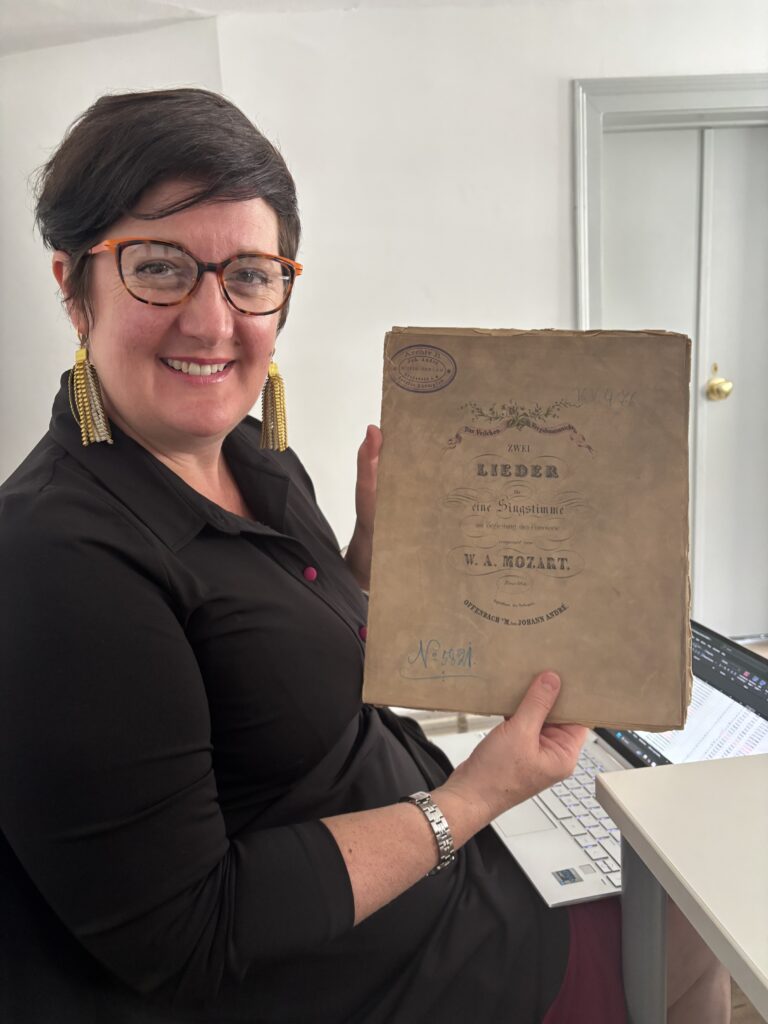
Nov. 2025 Andre Catalogue and Paper
Mar. 2026 NorthWestern
Briefly describe the timeline event providing your audience with all the details they need to know about it.
Mar. 2026 Julliard
Apr. 2026 Cagliari
Connecting Methods: Convegno Ricerca, Cagliari, Sardinia, Italia
This presentation explores how theoretical reflection, artistic experimentation, and creative practice intertwine within historically informed approaches to nineteenth-century vocal and pianistic repertoire, using Goethe, Schubert, and Liszt as interlocking case studies. It argues that creative practice can function as a form of historical inquiry when grounded in close engagement with primary sources, performance traditions, and embodied experimentation.
The starting point is Johann Anton André’s (1775–1842) Lieder und Gesänge for voice and piano, a 4-volume didactic collection notable for its extraordinary density of expressive markings. Goethe is known to have visited André in Offenbach am Main in the early years of the nineteenth century and reportedly recited his poetry to him, raising the tantalising possibility that André’s detailed indications capture aspects of Goethe’s own rhetorical delivery. Read in this light, André’s settings provide a rare window onto late eighteenth- and early nineteenth-century expectations of vocal and pianistic declamation, phrasing, and expressive nuance—expectations largely absent from the comparatively sparse notation of Schubert’s songs.
This framework informs a second case study centred on Schubert’s Erlkönig and Franz Liszt’s piano transcription of the song. Liszt’s version intensifies expressive marking and assigns the four characters to distinct registral and timbral zones of the keyboard, effectively translating vocal rhetoric into pianistic terms. Striking parallels emerge when Liszt’s conception is considered alongside early recordings by Ernestine Schumann-Heink (1861– 1936) and the spoken recitation of Goethe’s poem by the Austrian actor Alexander Moissi (1979–1935), both trained within Viennese traditions of rhetorical delivery. These performances suggest a shared expressive language encompassing timing flexibility, colouristic contrast, and character differentiation across voice, speech, and piano.
The final strand presents recent collaborative practice-led projects. Anna Fraser and Neal Peres Da Costa have recorded Schubert’s Schwanengesang using Liszt’s transcriptions (amongst other sources) as a form of reverse engineering. In parallel, Connor Fogel has recorded Liszt’s Erlkönig. In both artistically-driven projects the performers have embedded historically documented declamatory practices such as rhythm and tempo modification, sliding and trembling effects, and manual asynchrony and arpeggiation. Presented jointly, these projects demonstrate how theory, experimentation, and creative practice can operate as a single, mutually reinforcing process of historical and artistic discovery.
May 2026 Schubert: Schwanengesang Recording (DXL 1231)
Sold by Deux-Elles Records, Norwich, UK
This is the second commercial recording to emerge from the groundbreaking Australian Research Council Discovery Project, The shock of the old: Rediscovering the sounds of bel canto 1700–1900, led by scholar-performer Neal Peres Da Costa. Following the success of his iconoclastic recording of Schumann’s Dichterliebe with baritone Koen van Stade (DXL1193), he joins forces here with soprano Anna Fraser to imagine the sound of Schubert’s own Schubertiades, with the help of an astonishing set of recordings of singers trained in the 1830s and 40s. Especially innovative are Fraser’s experiments with varying the timbre of her voice within phrases, guided by techniques described in Manuel Garcia’s vastly influential vocal method in combination with other historical sources. The result is startling at first, but delivered with a warmth and charisma that transcends all boundaries of style and convention.
Jun. 2026 Sydney Symposium
Hearing the sounds of Dr Goethe: Historical artefacts enlivened through experimental artistry
This presentation explores how theoretical reflection, artistic experimentation, and creative practice intertwine within historically informed approaches to nineteenth-century vocal and pianistic repertoire, using Goethe, Schubert, and Liszt as interlocking case studies. It argues that creative practice can function as a form of historical inquiry when grounded in close engagement with primary sources, performance traditions, and embodied experimentation. The starting point is Johann Anton André’s (1775–1842) Lieder und Gesänge for voice and piano, a 4-volume didactic collection notable for its extraordinary density of expressive markings. Goethe is known to have visited André in Offenbach am Main in the early years of the nineteenth century and reportedly recited his poetry to him, raising the tantalising possibility that André’s detailed indications capture aspects of Goethe’s own rhetorical delivery. Read in this light, André’s settings provide a rare window onto late eighteenth- and early nineteenth-century expectations of vocal and pianistic declamation, phrasing, and expressive nuance—expectations largely absent from the comparatively sparse notation of Schubert’s songs.
This framework informs a second case study centred on Schubert’s Erlkönig and Franz Liszt’s piano transcription of the song. Liszt’s version intensifies expressive marking and assigns the four characters to distinct registral and timbral zones of the keyboard, effectively translating vocal rhetoric into pianistic terms. Striking parallels emerge when Liszt’s conception is considered alongside early recordings by Ernestine Schumann-Heink (1861– 1936) and the spoken recitation of Goethe’s poem by the Austrian actor Alexander Moissi (1979–1935), both trained within Viennese traditions of rhetorical delivery. These performances suggest a shared expressive language encompassing timing flexibility, colouristic contrast, and character differentiation across voice, speech, and piano. The final strand presents recent collaborative practice-led projects. Anna Fraser and Neal Peres Da Costa have recorded Schubert’s Schwanengesang using Liszt’s transcriptions (amongst other sources) as a form of reverse engineering. In parallel, Connor Fogel has recorded Liszt’s Erlkönig. In both artistically-driven projects the performers have embedded historically documented declamatory practices such as rhythm and tempo modification, sliding and trembling effects, and manual asynchrony and arpeggiation. Presented jointly, these projects demonstrate how theory, experimentation, and creative practice can operate as a single, mutually reinforcing process of historical and artistic discovery.