Further Links
Youtube
Performance
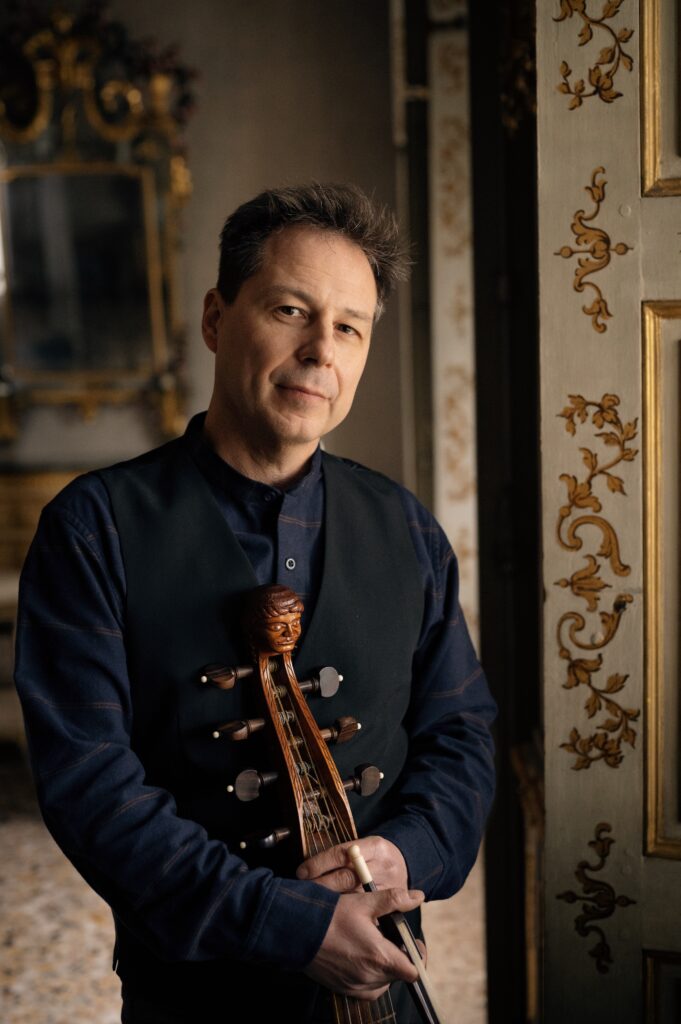
Guido Balestracci
Guido Balestracci was born in Turin in 1971. Immediately after completing his studies at the Schola Cantorum in Basel, he began a long-standing collaboration with musical figures such as P. Pandolfo and J. Savall.
In 1997, he founded the ensemble L’Amoroso in order to explore the repertoire for the viola da gamba in a more personal way and to highlight the various instruments within this family. The recordings Consonanze Stravaganti, Seconde Stravaganze and the transcription of Corelli’s Opus V for viola da gamba are regarded as pioneering works in the revival of the Italian repertoire for violas da gamba and have been acclaimed by international critics.
Passionate about research, G. Balestracci takes an interest in rare instruments, such as the baryton, as evidenced by a CD dedicated to Haydn’s trio divertimenti, released in 2011.
It is within this context that his interest in the Classical and Romantic periods lies, and more specifically in the arpeggione, of which he is one of the few contemporary performers. He has since performed in concert, in a programme devoted to transcriptions of the Romantic repertoire centred on Schubert’s Arpeggione Sonata, which he recorded in 2019.
G. Balestracci was also in charge of the research project Vibrato between 1770 and 1820: an ornament to be rediscovered, at the HEM in Geneva. Following on from this, in 2026 he launched the project Bel suono and Belcanto: a reversed practice of imitating instruments with the voice during the Romantic era.
His next recording, devoted to François Couperin’s suites for viola da gamba, is due for release in early 2027.
He holds the post of professor of viola da gamba and 18th-century ornamentation at the HEM in Geneva and at the CRR in Paris.